Cannabis Basics
Honest notes from 900+ dispensary visits. Zero sponsored posts.
Get the lists
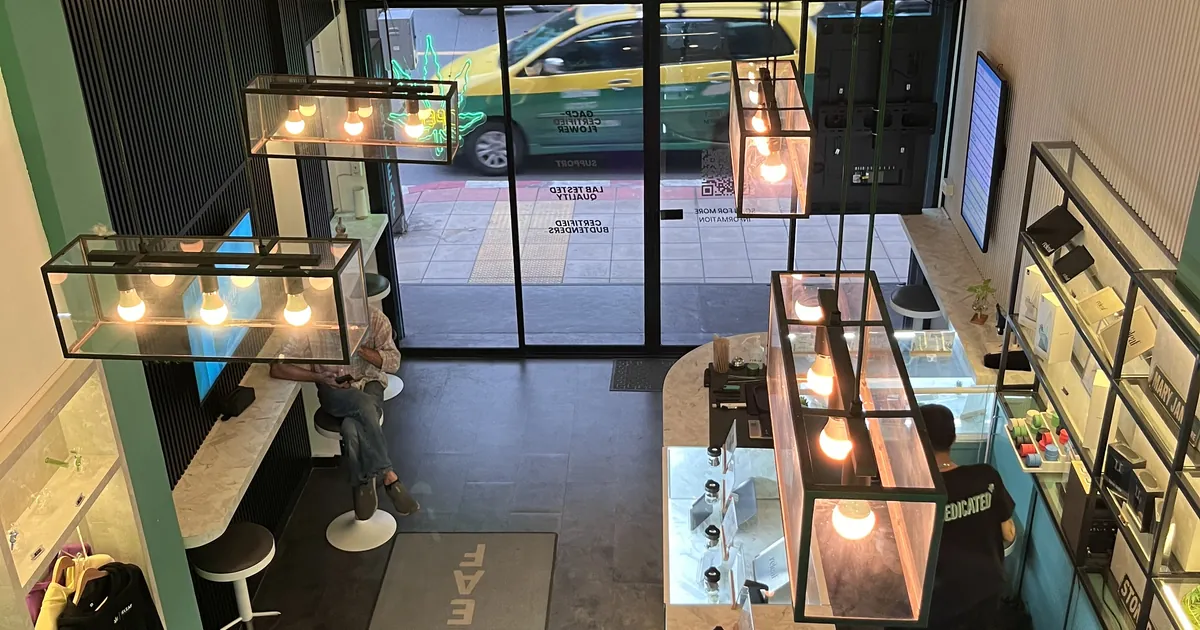
Every so often, someone at a Bangkok dispensary counter asks for a Thai stick. They say it the way you would ask for a famous dish in the country it came from. Surely, here of all places, they will have the real thing.
Usually the budtender smiles, reaches for a jar of something with an American name, and the moment passes.
A Thai stick is Thai cannabis flower tied around a thin stick, traditionally bamboo or a hemp stalk, bound with fibre or string, then cured and smoked like a cigar once the stick is pulled out. It became famous in the United States in the late 1960s and 1970s, when Thai weed was carried home by American servicemen and smuggled by the tonne. Over time the name stuck to three other things as well: a Thai landrace strain, a way of packing weed for transport, and a marketing label for any bud on a skewer.
That is the short answer. The longer one is more interesting, and most pages about it were written a long way from Thailand. I have spent about four years in the Thai cannabis scene and walked into more than 900 dispensaries here. This is the version from this side of the world.
The writer John McMahon, who has lived in Thailand for more than 20 years, makes a useful point in his history of the Thai stick: he has heard it called a strain, a transport method, a kind of blunt and a marketing ploy. People argue past each other because they mean different things. Here is how I break it down.
A preparation. Buds bound around a stick, sometimes wrapped in fan leaves, then cured. This is the original meaning and the one I use on this site.
A strain. "Thai" is listed by strain databases as a pure sativa landrace native to Thailand, with "Thai Stick" as an alternative name. I unpack this in the Thai stick strain guide.
A transport method. Bundled sticks were a neat, standard unit for moving weed. A Bangkok Post feature on the smuggling era describes 20 sticks to a bundle and 100 bundles weighing about three and a half kilos.
A marketing label. Once the name was famous, dealers sold any bud tied to a stick as a Thai stick. McMahon describes buying one in a Brooklyn park that turned out to be two bamboo skewers with ordinary weed tied on.
So when someone asks "what is Thai stick weed", the honest answer is: it depends who is selling it to you.
Most American pages say Thai sticks were made by "the hill tribes of northeast Thailand". That phrase falls apart the moment you look at a map of Thailand.
Thailand's hill tribes live mostly in the high mountains of the north and west. The northeast is Isan, a broad plateau of 20 provinces bordered by the Mekong and Laos. They are different regions with different peoples.
The historian Peter Maguire, who interviewed hundreds of smugglers and agents for his book with Mike Ritter, places the source of the famous product in Isan, and told VOA it was grown in Laos as well. Writing in The Diplomat, he describes Isan's silty Mekong soils as ideal for the crop, and Isan farmers removing male plants, drying the buds and tying them to small bamboo sticks with hemp fibre. Thailand's own scientists still study a traditional cultivar from the Phu Phan range in Isan, which I cover in what is left of Thailand's native weed.
The sources do not agree on everything. Some credit hill tribes, some credit Isan farmers, and nobody has a date for the first Thai stick. Most of them point to Thailand's northeast, with Maguire adding the Lao side of the Mekong. Whoever tied the first one, the people who made them knew exactly what they were doing.
The craft varied by source, and I go through it properly in how a Thai stick is made. The broad shape is consistent:
Seedless buds. Growers culled the male plants so the females put their energy into dense, seedless flowers.
A thin stick. A Bangkok Post account describes a bamboo stick about five and a half to six inches long, "much like a satay skewer".
A binding. Accounts mention cotton or bamboo fibre, hemp fibre, or silk line.
A cure. Several sources describe wrapping the stick in fan leaves and burying it to cure, for about a month in one account and up to three months in another.
Some accounts add a coat of hash oil between layers. Others, including Maguire's, describe only buds, bamboo and fibre. That disagreement matters, and it leads straight to the most famous myth.
Ask an American who smoked in the 1970s about Thai sticks and there is a good chance you will hear that they were dipped in opium.
Here is what the sources actually say. Wikipedia and Weedmaps both describe opium dipping as something that may or possibly happened, not as a fact. High Times repeats it as a story from veterans, including the writer's own father, with no evidence offered. Nobody I could find documents it.
Two things make me sceptical. Opium was valuable in its own right, so soaking cheap weed in it makes little commercial sense. And Thailand had ordered an end to opium smoking and sale in December 1958, then burned more than 8,000 opium pipes at Sanam Luang, years before the Thai stick boom. Opium never vanished from the wider region, so this is a reason for doubt, not proof. The more likely explanation is simpler: the weed was strong, the smokers were not used to strong weed, and a legend was born.
I would treat "opium dipped" the way I treat most dispensary stories. Possible, unproven, and usually told by someone who was not there.
The numbers explain a lot. Maguire reports that in the early 1970s Thai weed sold for about $3 a kilo at the farm in Isan and about $4,000 a kilo in American cities. One veteran told the Bangkok Post you could trade an 80 cent bottle of gin from the military store for a pack of 20 Thai sticks.
Tens of thousands of American servicemen were stationed in Thailand during the Vietnam war. The first Thai weed reached the United States through the military post. Surfers, sailors and later professional criminals built a trade around it. I tell that whole story in Thai stick in the 1970s.
Maguire's verdict in a VOA interview was blunt: Thai weed "was probably the best marijuana in the world."
This trips up a lot of people, so to be clear: a Thai stick is a preparation, not one single strain. The original sticks were made from Thai landrace sativa, local plants adapted over generations to Isan's climate. Strain databases now list "Thai" and "Chocolate Thai" as landrace strains, and some modern seed is sold as "Thai Stick".
Leafly describes Thai as energising, with a long growth cycle and slow flowering that makes it hard to grow outside the tropics. That long flowering is one reason the old genetics became rare once growing moved indoors. For the full picture, including Golden Thai and what the "Thai" names on Bangkok menus really are, read the Thai stick strain guide.
Legally, a Thai stick is just cannabis flower on a stick. That means the rules for buying it are the rules for buying any flower in Thailand. You need a PT33 prescription from a Thai licensed practitioner and a licensed dispensary. My PT33 guide walks you through getting one, and is weed legal in Thailand covers the wider law.
There is one catch the American guides never mention. Many modern Thai sticks are coated in hash oil or concentrate. In Thailand, extracts above 0.2% THC are treated as category 5 narcotics. A plain stick of flower is one thing. An oil soaked one is a different legal conversation.
The other honest truth is that authentic, old method Thai sticks are rare on Bangkok menus. I explain why, and where to look for Thai genetics instead, in can you still buy a real Thai stick in Bangkok. Whatever you buy, check the shop on the ThaiCannaMapped Dispensary Register first.
Reading the pages that rank for this word, I kept noticing what is not there.
Thailand itself. Most tell the story as an American one, about soldiers, surfers and smugglers. The farmers in Isan barely appear.
How long it was gone. A Thai respiratory doctor, Dr Manoon Leechawengwongs, wrote in 2022 that young Thais today no longer know what a Thai stick is. A Thai newspaper rendered it in Thai as "cannabis on a skewer". The legend lived on in America while it faded at home.
The plants are still here. Thai researchers have sequenced the genome of a traditional cultivar called Hang Kra Rog Phu Phan, described as an indigenous variety with a long history in traditional medicine. The legend has a living relative.
The law changed. Thailand went from prison sentences to medical cannabis to open shops and back to a prescription model in a few short years. I covered that arc in how cannabis got banned and why Thailand unbanned it.
What is a Thai stick in simple terms? Thai cannabis buds tied around a thin bamboo stick or hemp stalk, bound with fibre, often wrapped in fan leaves and cured, then smoked like a cigar with the stick removed.
Is a Thai stick a strain? Not originally. It is a preparation made from Thai landrace sativa. "Thai" and "Chocolate Thai" are the strain names most linked to it.
Were Thai sticks dipped in opium? There is no documented evidence. Sources that mention it say "may have been" or pass on veterans' stories.
Why is it called a Thai stick? Because the buds were tied to a stick and the weed came from Thailand. Simple as that.
Is a Thai stick legal in Thailand? Plain flower on a stick follows the same rules as any flower: a licensed shop and a PT33 prescription. Oil coated versions bring extract laws into play.
The Thai stick is a strange thing. It is one of the most famous names in cannabis history, and almost nobody alive has smoked a real one. The country that made it largely forgot it, and the country that consumed it turned it into folklore.
I have been documenting Thailand's cannabis scene on Instagram for years, and the Thai stick question comes up more than you would expect. The people who know the most about where Thai genetics went sit inside Reefers Club, an invite only community of people working in the Thai cannabis industry. And if you run a shop and want to tell stories like this one without breaking the advertising ban, that is the marketing and content work I do.
If you want to taste the modern descendants of that legend in a licensed Bangkok shop, start with the curated lists.
Written by someone who has heard "do you have Thai sticks?" at a lot of Bangkok counters, and finally went and found out why the answer is usually no.
This article is for general and historical information only and is not legal or medical advice. Legal purchase of cannabis flower in Thailand requires a PT33 prescription and a licensed shop. Consume in private only. Adults 20+ only.